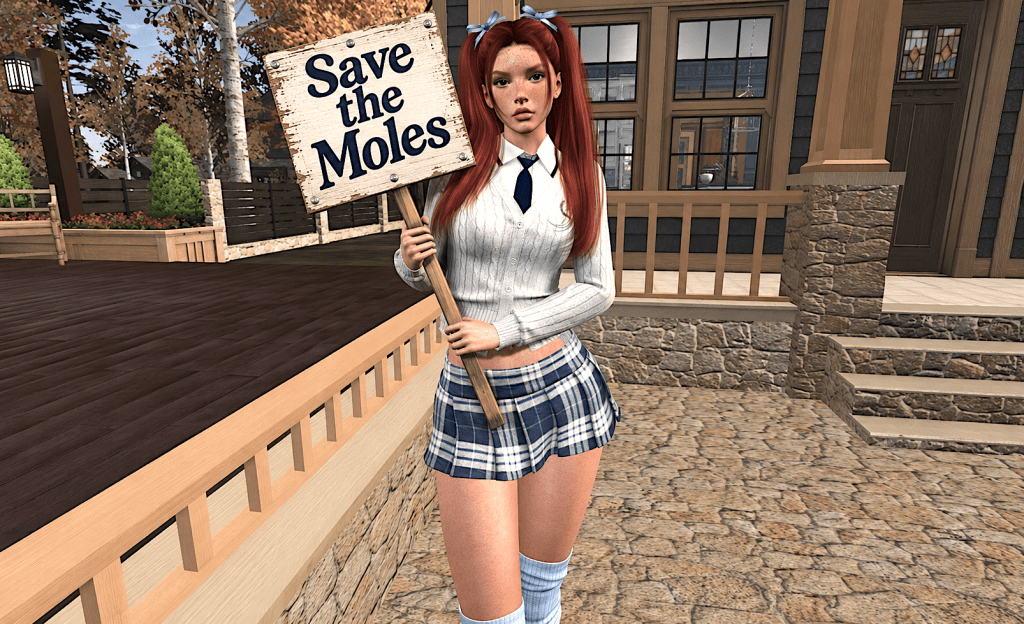
For many years, the Moles have been an institution within Second Life. Now, a decision to replace their distinctive surnames and retire the Linden Department of Public Works identity has raised questions about tradition, trust, and the preservation of Second Life’s cultural heritage.
Second Life has never been simply a virtual world. Over more than two decades, it has developed its own institutions, traditions, customs, and shared history. Some of these were created by Linden Lab, while others emerged organically from the residents who have made the platform their virtual home. Together, they form a cultural identity that distinguishes Second Life from virtually every other online environment.
Among the most recognizable and beloved of these institutions is the Linden Department of Public Works, better known as the LDPW, and the talented individuals who have traditionally carried the distinctive surname Mole.
Now, that tradition may be coming to an end.
Linden Lab’s move to replace the familiar Mole surnames with conventional last names, accompanied by the transition of the LDPW identity to Second Life Studios, has generated a wave of criticism from residents who see the changes as unnecessary, poorly considered, and potentially damaging to the relationship between the company and its community.
An October 26, 2026, community feedback proposal titled “Restore ‘Mole’ & ‘LDPW’ Names Back to Second Life,”submitted by SarahKB7 Koskinen, has become a focal point for the opposition. The proposal attracted more than 300 votes in less than a week, according to comments posted in the discussion, with residents expressing concerns ranging from historical preservation to the practical matter of identifying legitimate Linden Lab representatives.
But beneath the objections lies a larger question: In its efforts to modernize Second Life, is Linden Lab inadvertently dismantling some of the very traditions that make the world worth preserving?
Who Are the Moles, and Why Do They Matter?
For residents unfamiliar with the history, the Moles are the builders, designers, and creators who have worked on Linden Lab’s public infrastructure and community projects through the Linden Department of Public Works.
Since the LDPW’s establishment in 2008, their contributions have become woven into the physical and cultural landscape of Second Life.
Roads, bridges, waterways, public buildings, parks, recreational facilities, and entire communities have benefited from their craftsmanship. The Moles have been responsible for some of the most recognizable public spaces in the virtual world, including extensive work on the mainland and the development of Linden Homes environments. My own Linden home was built by a Mole.
Their contributions extend beyond construction. The Moles have frequently represented the more approachable, personable side of Linden Lab, appearing at community events, answering questions, interacting with residents, and occasionally sharing a bit of humor along the way.
The Mole surname became more than a convenient identifier. It was a recognizable symbol of craftsmanship, responsibility, and service to the Second Life community. To encounter someone named Mole was to encounter a person whose work was connected to the development and maintenance of the world itself. For many residents, that distinction carried considerable meaning.
A Name That Became Part of Second Life’s Culture
One of the most compelling arguments against the change is that the Mole identity has long since transcended its original administrative purpose.
It has become part of Second Life’s folklore.
Consider Bay City’s annual Mole Day, a celebration recognizing the contributions of the LDPW and the people who have helped build the world around us. The event has become an established community tradition, bringing residents together to celebrate the creators whose work often goes unnoticed in everyday life. I attended my first one (admittedly) just this year.
As SarahKB7 Koskinen asks in the original proposal:
“What will Bay City’s 2027 ‘Mole Day’ become known as? ‘Second Life Studios Day’? Bleh.”
The question is humorous, but it illustrates a serious concern.
What becomes of the traditions built around a name when the organization responsible for that name decides it is no longer necessary? What happens to places such as Mole Mart in Leafminer or Mole Island at Meauxle Bureaux? What becomes of the countless references to the LDPW scattered throughout Second Life’s historical records, community publications, landmarks, and resident memories?
Those places and traditions do not necessarily disappear because an organization changes its name. But the connection between their origins and the people responsible for them becomes less immediate, particularly for newer residents who may never encounter the original terminology.
The danger is not that Second Life’s history will suddenly be erased. It is that the historical continuity connecting its past to its present will gradually become harder to recognize, and in a virtual world where so much of the historical record depends upon residents remembering, documenting, and preserving it, that distinction really matters.
The Practical Problem of Trust and Identification
Beyond nostalgia and tradition, residents have raised an important practical objection: the Mole surname has served as a readily recognizable means of identifying people working on behalf of Linden Lab, and just as much as the Linden surname identifies company personnel, Mole has traditionally indicated a connection to Linden Lab’s public works operations.
Replacing that distinctive surname with conventional names potentially removes a useful visual distinction between official contractors and ordinary residents.
Longtime resident Evan Gingerpaw, who describes nearly 22 years in Second Life, summarized the problem:
“When someone with the last name Mole shows up to help you with something, you know they’re working for Linden Lab.”
The concern becomes particularly relevant when residents are approached by individuals claiming to represent Linden Lab or requesting cooperation with official projects. Commenters describe being advised to verify contractor identities by examining membership in Linden-owned groups that are not open to public enrollment. However, several residents questioned whether this was a practical or reliable solution.
Elfi Stoker pointed out that many residents, especially newcomers, may not know how to examine group memberships or distinguish legitimate official groups from others. Many of these are tricks picked up over time and experience.
Radioactive Rosca raised another complication, reporting that the LDPW group contained 207 members but that only 63 were visible through the publicly accessible group information. If those figures are accurate, group membership alone would not provide a consistently accessible method of verification.
There is an important distinction here: a recognizable surname is not, by itself, a complete security system, and residents should never rely solely on an avatar’s name when evaluating sensitive requests. Nevertheless, removing a familiar identifier without providing an equally clear alternative risks making ordinary interactions more confusing.
As Serene Vella observed, the Moles were among the few people working for Linden Lab whom residents could routinely encounter and interact with in-world. That visibility helped establish familiarity and trust.
The question Linden Lab should be asking is not simply whether a new naming convention works administratively, but whether it works for the residents who must interact with the people using it.
Change Should Not Require Erasing Identity
Organizations evolve over time. Names change. Departments are reorganized, responsibilities expand, and new operational structures emerge. There may be perfectly legitimate business reasons for Linden Lab to consolidate creative operations under a broader identity such as Second Life Studios.
Perhaps the company envisions a more expansive creative department whose responsibilities extend beyond the traditional work of the LDPW. Perhaps it wants to establish a unified identity for its designers, builders, and other creative professionals. Those possibilities certainly deserve consideration, although the comments supplied in this discussion do not establish Linden Lab’s specific reasoning.
But even if the organizational restructuring makes sense, it does not necessarily follow that the Mole identity must disappear. The two concepts are not mutually exclusive.
Second Life Studios could exist as an organizational umbrella while the Linden Department of Public Works continues as a recognized division, program, or historical identity. Likewise, individuals involved in public works projects could retain the Mole surname as a distinctive professional designation.
This would allow Linden Lab to modernize its internal organization without sacrificing a tradition that residents have recognized for ages.
Indeed, many organizations deliberately preserve historic names, symbols, and ceremonial identities through generations of restructuring precisely because those traditions have value beyond their immediate administrative functions.
There is no obvious reason why Second Life should be different.
The Importance of Institutional Memory
I think that Second Life is approaching an age when the preservation of its own history should be a greater priority, not a lesser one. The virtual world has already experienced the disappearance of countless landmarks, institutions, estates, communities, and creative projects. Some have been carefully documented, while others survive only in photographs, archived publications, and the memories of longtime residents.
The LDPW represents something unusually enduring within that changing environment because it is an institution whose work has helped shape the world continuously across multiple generations of residents. The Mole surname provides a visible connection to that history.
When examining an older public build, discovering that its creator carries the Mole surname can immediately communicate something about its origins. It places the work within a recognizable tradition of official public construction.
Removing that naming convention from future projects risks creating an artificial divide between the historical LDPW and whatever succeeds it. Future residents may encounter two different identities associated with the same institutional lineage without understanding their relationship.
That may seem like a minor inconvenience today. Over another decade or two, however, such changes can contribute to the fragmentation of institutional memory and for a platform whose greatest asset is arguably the accumulated creativity of its residents and builders, preserving those connections should be an important consideration.
A Community Asking to Be Heard
The response to the proposal has been notable not merely for the number of objections, but for the variety of concerns expressed. Some residents see the change as an affront to tradition. Others consider it an unnecessary complication for trust and safety. Still others worry that it reflects a broader tendency to make decisions affecting Second Life’s culture without adequately considering the community’s attachment to established institutions.
Zia Underwood described the Mole identity as an undeniable part of Second Life’s history and warned that removing ingrained cultural traditions can damage an online community.
Tai Doll offered a simpler observation:
“Some charm and ‘traditions’ are helpful to keep community cohesion.”
Pixie Lerner expressed appreciation for seeing Moles at work and argued that they deserve to retain the name. Other commenters have called for public demonstrations, while several have simply asked Linden Lab to reconsider.
Not every resident will necessarily agree. Some may regard the change as little more than an administrative adjustment, and others may welcome a broader identity for Linden Lab’s creative operations. The discussion also does not establish whether the proposed changes apply equally to existing Mole accounts, future hires, or both. Those details deserve clarification.
Nevertheless, the objections reveal that the issue extends well beyond a preference for familiar names. Residents are expressing a desire for continuity, recognition, and a meaningful voice in decisions affecting the cultural fabric of their virtual world.
Rebuilding the Relationship Between Linden Lab and Its Residents
Perhaps the most significant theme emerging from the discussion is the relationship between Linden Lab and the community it serves. Evan Gingerpaw recalled an earlier era when Linden employees routinely appeared at resident gatherings, visited clubs, attended dances, and participated in everyday Second Life activities outside formal company events.
Those interactions helped create the impression that the people developing Second Life were also part of the world they were developing. The Moles have continued to embody much of that spirit. Their presence at public projects, community celebrations, and informal gatherings has often provided a tangible connection between the company and its residents.
At a time when Linden Lab has reason to strengthen community relationships, eliminating one of its most familiar and approachable institutional identities seems a curious direction to take. A company does not build trust simply by changing organizational charts, adopting new branding, or issuing statements about community engagement.
Trust develops through consistency, familiarity, transparency, and the sense that residents’ perspectives matter. The Mole tradition has contributed to that relationship for nearly two decades, so why discard an asset that has taken so long to establish?
There Is a Reasonable Compromise
This controversy need not become a confrontation between progress and preservation.
Linden Lab can pursue its organizational goals while respecting the traditions that residents have embraced. Retaining the Mole surname for public works personnel, preserving the LDPW identity as a recognized part of Second Life Studios, and maintaining clear methods for verifying official representatives would address many of the concerns raised in the discussion.
The company could also provide a fuller explanation of the proposed changes, including their intended purpose, their effect on existing personnel, and how the historical contributions of the LDPW will continue to be recognized.
Most importantly, it could engage directly with the community before finalizing changes that affect long-established cultural institutions. Such an approach would demonstrate that modernization and respect for history can coexist and it would also acknowledge an important reality: although Linden Lab owns and operates the platform, the cultural identity of Second Life has been shaped collectively by the company and its residents.
Neither can fully separate its contributions from those of the other.
Some Traditions Are Worth Keeping
In the end, the controversy surrounding the Mole surname is about much more than a collection of avatars sharing a last name. It’s about identity, about history and about the relationship between a virtual world’s creators and the people who inhabit it.
And perhaps most importantly, it’s about recognizing that traditions which may appear insignificant from an administrative perspective can hold enormous meaning for the community that has embraced them.
The Moles have helped build Second Life, quite literally, from the ground up. Their work is visible across the mainland, within public spaces, and throughout the communities that residents call home.
Their distinctive name has become a small but enduring symbol of that contribution.
Second Life Studios may well be an appropriate name for an evolving creative organization. But there is no compelling reason, at least none evident from the information presented in this community discussion, why its establishment should require the retirement of the Mole identity or the disappearance of the Linden Department of Public Works from the world’s continuing story.
Linden Lab should reconsider the decision, preserve the Mole surname, and find a way for the LDPW tradition to continue within whatever organizational structure comes next.
Because Second Life is not merely a product to be managed. It is a living community with a history worth respecting and after many years of building the roads, bridges, neighborhoods, and landmarks of our virtual world, surely the Moles have earned the right to keep their name.
Some things are worth preserving, not because they are old, but because they have become part of who we are.
See you next time!
~ Arabella
Post Notes
Link to Forum: https://feedback.secondlife.com/ldpw/p/restore-mole-ldpw-names-back-to-second-life
Sponsored by:
This post may be updated as more information becomes available.


Leave a Reply