
Halloween is now behind us, and the Thanksgiving and Christmas Holidays loom in the weeks ahead. So what do Second Life residents do in the meantime, in the periods of time between the major events of the year that so many of us get caught up in? Playing games is one way to pass the time, and some are great ways to meet others, make new friends, and forge relationships that can touch every part of our lives. In the vast digital world of Second Life, where residents can build empires of art, fashion, or fantasy, few games have endured as long—or inspired as much loyalty-or controversy—as Tiny Empires.
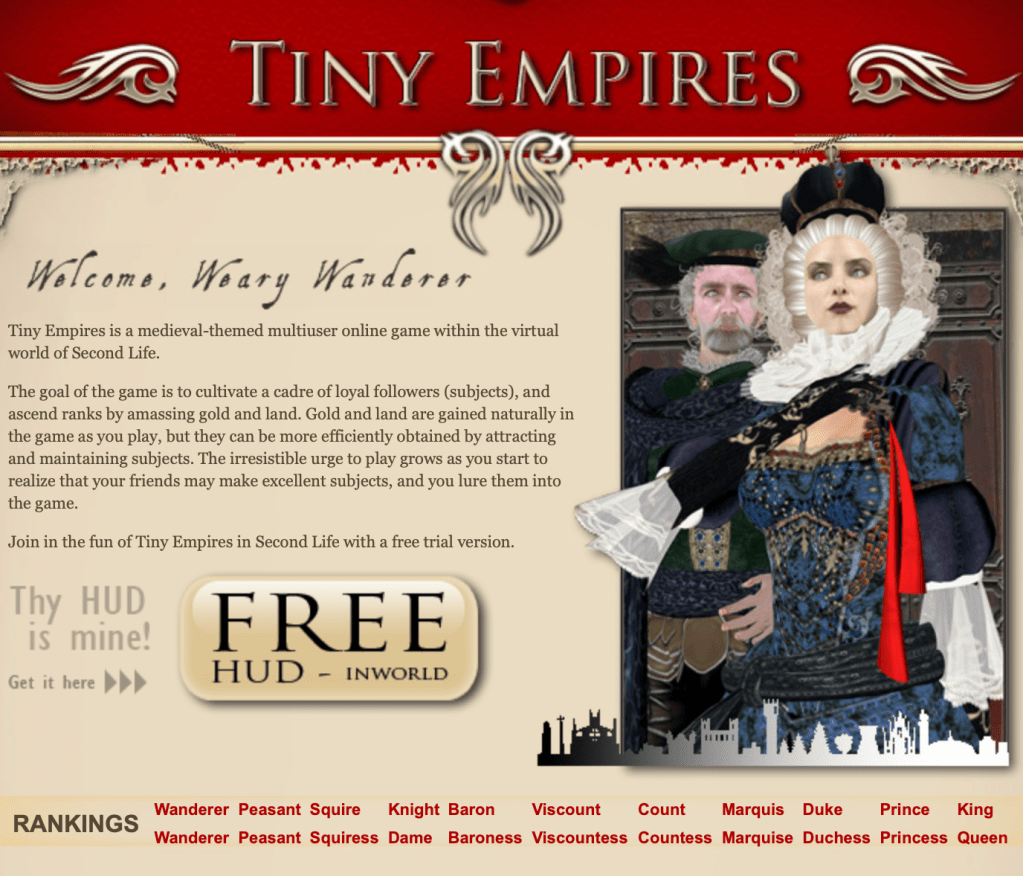
The brainchild of Second Life resident Ultralite Soleil, who is the overarching Emperor of Tiny Empires, and often described as a game within the game, Tiny Empires turns the ordinary act of socializing into a strategic pursuit of virtual nobility, fortune, and power. Whether you think Second Life is a game or not is, of course, a matter of its own debate, and it has in fact been debated since pretty much day one. Tiny Empires, however, truly is a game by my definition, which is to say it has definable goals, attainable objectives, and measurable outcomes, as well as requiring a level of strategic thinking. Moreover, it is designed to be played while you are doing other things in world as your game plays out on a hud that stays put on your screen. I should know. Hello, my name is Arabella, and I’m a Tiny Empires addict from the Kingdom of Scotland, one of many in the Empire of Terra Aurea.
A Game Built on Alliances
At its core, Tiny Empires is a text-based strategy and social networking game played entirely within the Second Life platform. It operates through a simple HUD (heads-up display) that allows players to make decisions, purchase land, form alliances, and climb through a feudal hierarchy as high as you want to go, or at least as high as your TE resources will allow.
One universal truth about Tiny Empires is that every single player starts at the same place: the bottom. Players begin as humble wanderers with no assets and two initial goals: to acquire some virtual acres and to find a liege to swear allegiance to. This begins the process of growing wealth and influence. Once they acquire said liege—another player higher in rank—they then become joined to a kingdom or queendom and begin their ascent. As you acquire more acres, either through purchase (you earn TE gold as you go along) or gift (higher players can grant you an acre of land if they choose), you rise in rank.
The first few promotions are relatively easy – one single acre elevates you from a wanderer to a peasant – but each new level requires a higher number of acres than the one before, so promotions become slower as you move along. The lower levels of Peasant, Squire, and Knight are attained by reaching 1, 5 and 10 acres respectively, then you enter the peerage ranks of Baron (25), Viscount (50), Count (100), Marquise (200), and ultimately, Duke (400). Yes, I’m royally pedantic and realize that the proper British ranks of Earl and Marquess have been fudged a bit for those of Count and Marquise, but I digress….and these are the male ranks too, which also come in the female equivalent depending on the gender you select at the time of your entry into the tiny world.
From there, the gap widens even more as you work your way up to the royal rank of Prince or Princess, requiring a thousand acres of virtual TE land. The good thing is while this can be a time consuming and laborious process, you can climb the ranks quicker by enticing other players lower in rank than you to join you as a subject, or even better, bring in new players under you that grow your acre total while working on their own. Over time, a player may become a powerful player, commanding vast virtual fiefdoms that stretch across the game’s sprawling network of players. Ultimately, it all comes down to the decision you choose each time the HUD updates, which gives you about 4 minutes between each turn to make a decision based on what the HUD offers you.
Strategy Meets Socialization
What makes Tiny Empires remarkable isn’t its graphics or mechanics – and it certainly isn’t an action game—it’s the people. The game thrives on the relationships between players. Choosing a liege isn’t just a strategic move; it’s often a social one. Strong leaders attract loyal followers, while poor leadership can cause subjects to defect to rival kingdoms or even other lines within their own kingdom.
Each decision carries weight: whether to buy land or save your gold for big purchases or productivity upgrades that boost your gold intake, whether to support one’s monarch or plot for independence. It’s a world where diplomacy, loyalty, and reputation matter as much as gold and land.
The Allure of Ascension
Tiny Empires taps into a simple but irresistible drive: the desire to progress. The game offers a sense of continuity rare in Second Life, where many experiences are fleeting or purely aesthetic. Tiny Empires provides structure—a ladder of achievement, a community, and a constant stream of events that shape its virtual society.
Titles and ranks are earned through steady participation, clever strategy, and sometimes shrewd alliances. For many, it’s not just a pastime; it’s an identity within Second Life’s broader social landscape. For some, achieving the rank of Prince or Princess is enough; for others, heading up long and impressive lines of players and managing your downline is the lure and the challenge…and then there are the monarchs, who are the singular heads of all the kingdoms and queendoms, which currently number at 416 total as of this writing. Each monarchy is ranked in order of the total number of acres under the control of the monarch, either a King or Queen. The largest kingdoms, those in the top 25, can have acre totals numbering between the hundreds of thousands into the low millions, and since the most acres a single individual can have on their own is just north of 3000 acres (with upgrades), this gives you an idea of how many players a monarchy must have to maintain those numbers. Those in the top 10 have acres numbering in the several millions, with thousands of players making up those totals. If this is starting to sound like a medieval pyramid scheme to you, well guess what? It is!
The Legacy and Community
Since its debut in July 2007 (Thank you, Emperor, for that clarification), Tiny Empires has grown into one of the most enduring and beloved roleplay-style games in Second Life. Its sequel, Tiny Empires 3000, even carries the concept into a futuristic setting, showing the versatility and staying power of its design.
Today, countless players still gather daily to check their HUDs, trade land, and navigate the ever-shifting loyalties of the virtual realm. Whole communities have formed around the game, with many of the still-active kingdoms and queendoms holding social gatherings, community events, and even owning Second Life land for their members to use and enjoy.
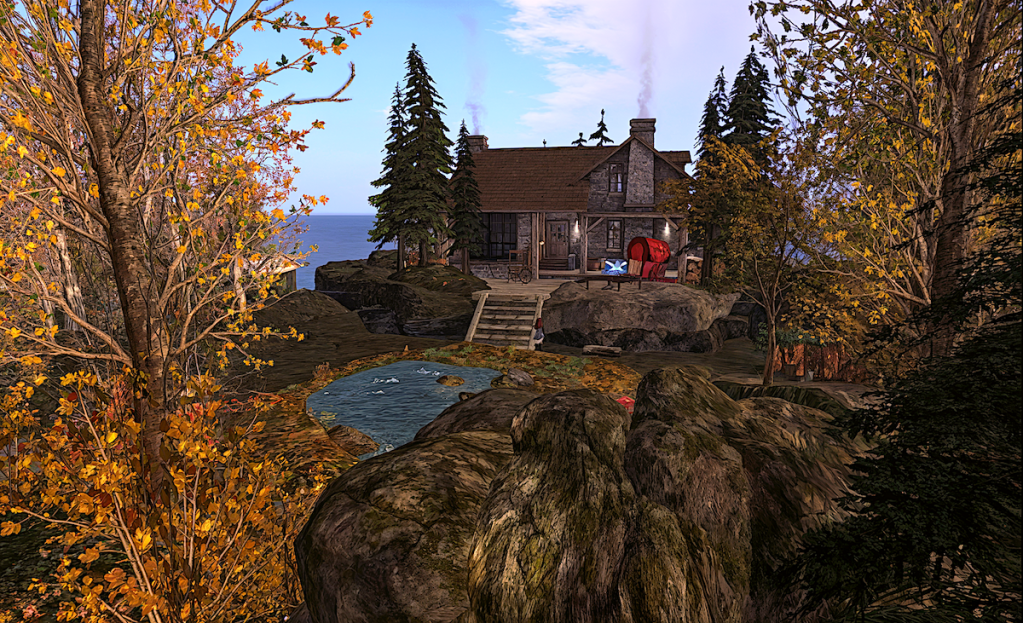
Our own Kingdom of Scotland makes its home in the virtual Highlands of Scotland in Second Life, a group of six regions that includes a number of resident players (as well as those who don’t and who just look at us like we’ve lost our minds sometimes). We hold Kingdom events, help fellow team players out and generally just have a good time in our virtual pursuits, all with the game running in the background of our regular activities. We’ve even formed social alliances with other kingdoms where players join their friends across lines for fun and activity in their daily SL lives.
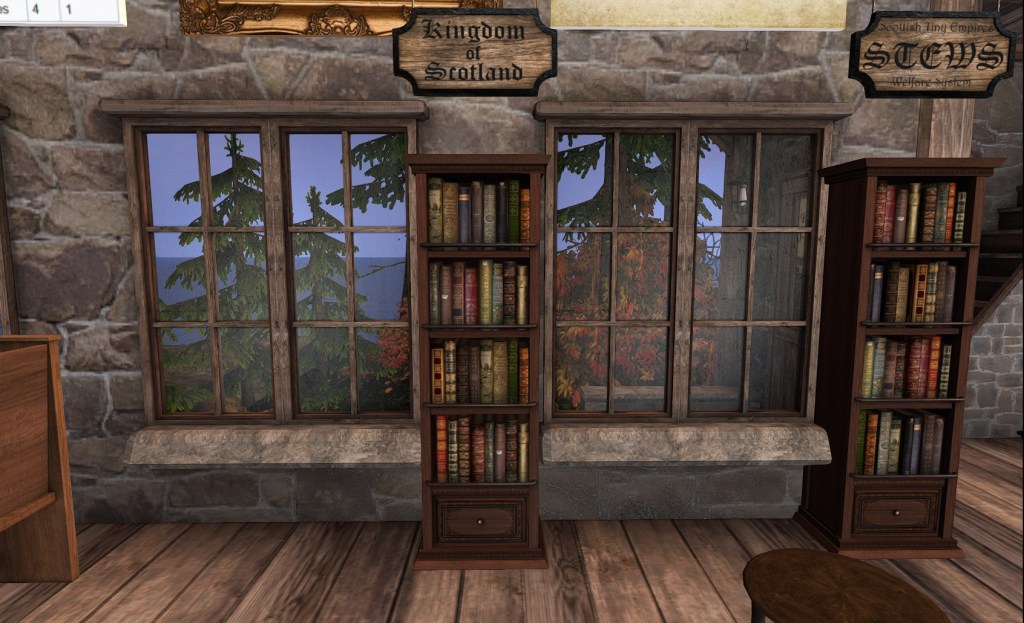
We have a headquarters too, the Royal Scotland Academy, where players from our Kingdom and others can come and do research, learn about the game and its strategies, and pick up a copy of our weekly newsletter (the gossip column, “Midge Bites”, written by Iliana Evergreen, is worth picking up a copy of just for the wit and humor she injects in each bit of news)! Tiny Empires remains a social phenomenon—part strategy game, part community, part digital courtly intrigue. I also enjoy playing Tiny Empires 3000 too, and hanging out with my crew in the Guild of Mystic Stars (A Guild is to Tiny Empires 3000 what a Kingdom is to Original Tiny Empires).
caveats
While it’s true that many monarchies are no longer active anymore – whether through player attrition (people leaving SL) or players’ having lost interest and stopped playing (in effect, removing their hud) – there are still quite a number of active, thriving Tiny Empires monarchies that have legions of dedicated players watching their huds and ticking decision boxes each turn. As I said, it runs in the background, and how much or little interaction you choose to have with your hud is all up to you.
Another source of confusion for some is the vast number of alts that some players use to play multiple game huds and boost their ranks and standings. This, of course is a personal decision, as Tiny Empires has very few rules about how the game is played and there is no right or wrong way to play it. This is also why some kingdoms engage in sabotage and drama (because they can) and why some choose to play with honor and fairness (because they can). You have to find a kingdom that fits you, including your personal gameplay preferences, desire for socialization, and so forth.
Speaking of that, not all are social kingdoms, and that’s ok too. Some enjoy just playing as a collective of individuals doing their own thing without a lot of interaction from others, while others find the game lacking without people to engage with, strategize with and yes, even gossip with. Many players check the TE website every day to see what has been going on within the vast Empire and its many kingdoms, including seeing which players have jumped ship to other kingdoms or lieges, who has been sabotaged (players in other kingdoms can target your acres under certain circumstances), or who has been given a suave new title by their monarch or one of their Viceroys or Vicereines that have been vested with some monarchial powers to wield on behalf of their King or Queen.
A Kingdom Without Borders
In a world as boundless as Second Life, Tiny Empires stands as proof that even in a universe built on pixels, the human desire for ambition, loyalty, and belonging never fades. Whether you’re a new settler or a reigning monarch, the empire you build in this game of tiny decisions might just become one of the biggest adventures you’ll have in Second Life.
Interested? Pick up a FREE game hud at the landmark below and try it out. Let yourself be assigned to a kingdom or queendom and make new friends or find a friend already playing and join them in their quest for glory and honor. You’ll find many monarchies that will be glad to have you aboard!
Happy Gaming!
~ Arabella
Post Notes:
Tiny Empires Vendors (Original and 3000): http://maps.secondlife.com/secondlife/Kitster/147/41/53
Kingdom of Scotland Royal Academy: http://maps.secondlife.com/secondlife/Dornoch/169/212/31
Tiny Empires Website: https://tinyempires.com
Want to play in a futuristic setting with space ships, space pirates and trade routes? Check out Tiny Empires 3000 Here: https://www.tinyempires3000.com


 Second Glances with Arabella
Leave a comment